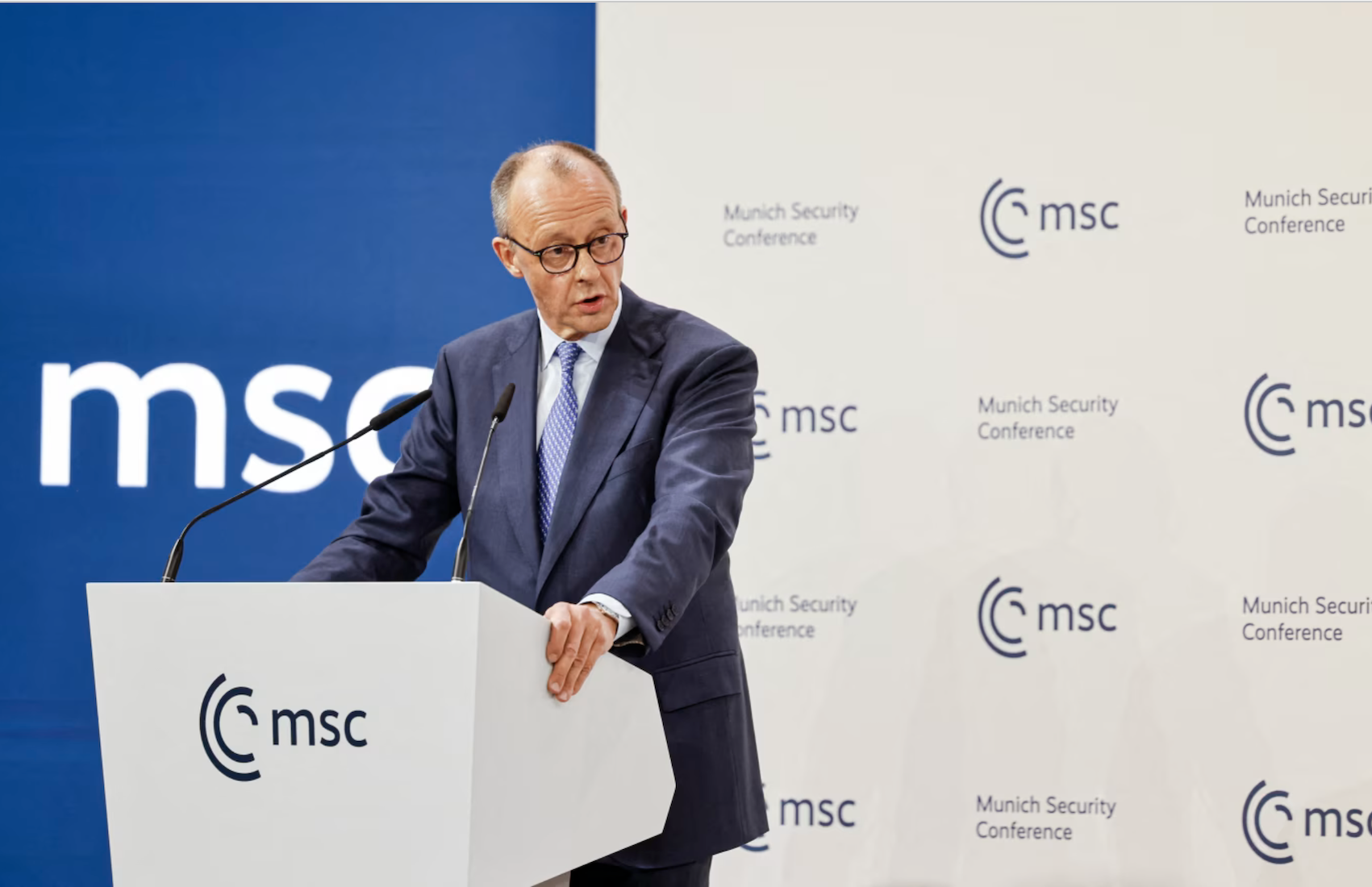
Munich, 16 February 2026 – Although the 62nd Munich Security Conference which drew to a close on Sunday coincided with Valentine’s Day, it was no love fest. On the contrary, in his opening speech on Friday, German Chancellor Friedrich Merz stated that the US and Europe no longer share the same values but only common interests. He went on to say that the US leadership on the world stage was perhaps already lost.
However, in his keynote speech on Saturday US Secretary of State Marco Rubio struck a more conciliatory tone in stating that Europe and US belong together and that the transatlantic alliance needs a strong Europe. This sentiment was also expressed in an important panel discussion about the future of Iran as US Senator Lindsey Graham and European Parliament President Roberta Metsola both agreed that there can be no future for the Islamic Republic. There now seems to be a broad consensus on both sides of the Atlantic that the Iranian people deserve their freedom after 47 years of oppression by the Islamic Republic.
Despite no formal endorsements by the international community it is becoming increasingly clear that it is Crown Prince Reza Pahlavi who is emerging as the unifying leader for the Iranian opposition and the most realistic alternative to the current Islamic regime. As a consequence, Pahlavi was invited to the Munich Security Conference and given a platform to present his transitional plan for a free and democratic Iran. On Saturday the Crown Prince spoke at the largest demonstration ever against the Islamic Republic outside of Iran as more than 1,3 million exiled Iranians came together across the world, some 250,000 of them in Munich, to show their support for the Crown Prince.
Apart from the ongoing Russian aggression in Ukraine and the fragile transatlantic alliance the discussions in Munich also focused on the emerging new world order which is gradually replacing the rule of law based international system of the postwar era.
Speaking at a side event on Saturday the chairman of the Foreign Affairs Committee in the United Arab Emirates, Dr Ali Rashid Al Nuaimi urged the Europeans to work together with the US administration to ensure a peaceful future in the Middle East. Although he did not doubt that Hamas can and will soon be militarily defeated, he called for an equally robust strategy to also defeat their ideology of religious hate and violence.
“This is not only the work of governments but also of civil society, including faith leaders,” he said. While warning about the consequences of modern algorithms which lead people to extreme views, he favoured bridge building and open dialogue, also with those with whom we disagree.
Chief Rabbi Pinchas Goldschmidt of the European Conference of European Rabbis pointed out that as long as the silent majority of people of reason remain silent, they are not a majority, and as long as they do not speak out they do not exist.
Presenting European Coalition for Israel as a coalition which is willing to speak up against antisemitism and other forms of hatred was therefore well received and appreciated in Munich as the international community struggles to preserve the post war peace and stability. In a statement after the conference ECI Founding Director Tomas Sandell contradicted the main message of Chancellor Merz by arguing that our transatlantic alliance can only be preserved through shared values, and not only by shared interests. These values include co-existence, pluralism and inclusion and are not limited to the Western world but are just as relevant in the Middle East where the historic Abraham Accords has the potential of breaking new ground and where the repressive Islamic Republic is on the verge of collapsing.
Sandell concluded, “In a time and age when Europe is obsessed with military strength and economic growth it may be worthwhile to pause for a moment to reflect on what former European Commission President Jacques Delors already in the 1990’s called the ‘Soul of Europe.’ Europe cannot regain its strength without rediscovering its values.”