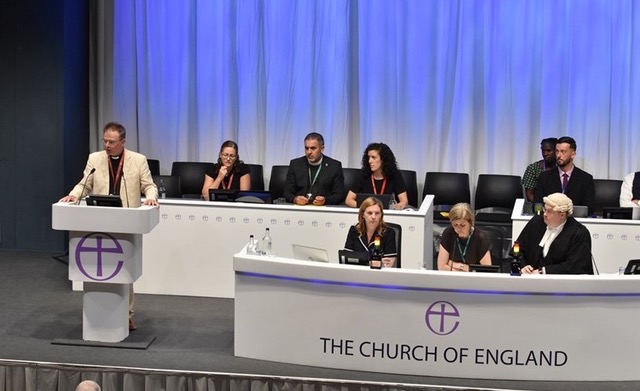
Brussels, 14 July 2026 – On Monday the General Synod of the Church of England voted to include the Kairos II document in a motion on the conflict in the Middle East. It did so despite warnings from the Chief Rabbi, Sir Ephraim Mirvis, and from prominent members of the Anglican community in the UK, among them the former Archbishop of Canterbury Lord Carey.
Kairos II, formally titled “A Moment of Truth: Faith in a Time of Genocide”, was drafted by the Palestinian Christian Ecumenical Initiative and launched in Bethlehem in November 2025. It has been unreservedly endorsed by the Global Kairos for Justice coalition and endorsed by the World Council of Churches, whose executive committee cited it approvingly in its statement of November 2025, and whose Central Committee in June 2025 called on churches and states to impose targeted sanctions, divestment and arms embargoes on Israel. The document accuses Israel of genocide, describes the Jewish state as “a colonial, settler and exclusionary entity”, and affirms that Palestinians are “the indigenous people of this land”. It rejects the very concept of a “conflict”, characterising the situation instead as settler colonialism and apartheid. It criticises the Abraham Accords, and calls on churches to distinguish between dialogue with Jews and dialogue with Zionism, going further still, urging them to “boycott dialogue with Zionist voices”. It also calls on churches to pressure their governments to isolate Israel, impose sanctions, boycott it and ban arms exports.
Writing about the terrorist attack of 7 October, the document appears to whitewash the greatest pogrom since the Holocaust by disputing Israel’s right to self-defence: “How can a colonizer defend itself against those it has colonized and expelled from their land?”
In a statement on Tuesday, ECI Founding Director Tomas Sandell criticised the document for “echoing Christian blood libels of the past and calling into question the very legitimacy of the modern State of Israel, despite the more than 3,000-year connection between the Jewish people and the land of Israel and its acknowledgement under international law dating back to the San Remo Peace Conference of 1920.”
“This is a tragic travesty of history,” Sandell said. “At the very moment when the State of Israel is doing what the international community and the church failed to do during the Holocaust, namely protect Jews from genocide, it is itself accused of committing one. The church must reject these modern blood libels, not endorse them.”
The Synod’s decision comes at a time when Britain is facing the worst epidemic of antisemitism in recent memory, fuelled chiefly by Islamic extremists and left-wing radicals. It is the same red-green alliance that lies behind the rise of the new antisemitism dating back to the World Conference against Racism in Durban, South Africa, in September 2001. A conference convened to fight racism has gone down in history instead as the launching pad for a global campaign to isolate and demonise the State of Israel through international lawfare, accusations of apartheid and genocide, and a campaign to boycott, divest from and sanction Israeli products. In 2009 the same narrative found Christian expression in the first Kairos document.
“The document serves the same function as the antisemitic *Protocols of the Elders of Zion* did in the past,” Sandell said. “It seeks to legitimise the most vicious lies and fabrications against the Jewish people, among them the notion of an international Jewish conspiracy and the modern blood libel of a Jewish genocide against the Palestinians.”
The European Coalition for Israel has a particular connection with Durban. The process that led to the Coalition’s formation began in September 2001, the same week as the world conference in South Africa. The Coalition was formally launched two years later, in 2003, at the European Parliament in Brussels, and has since been at the forefront of combatting antisemitism in Europe, with a special focus on Christian antisemitism.
At a Berlin symposium hosted by ECI in 2022, marking the 80th anniversary of the Wannsee Conference, the then Archbishop of Canterbury, Justin Welby, warned that “the world must be vigilant against the eruption of a volcano of antisemitism.” On Monday his successor, Dame Sarah Mullally, spoke in favour of the Kairos II document, despite the Chief Rabbi describing the motion as shameful and harmful for peace.
The European Coalition for Israel has been promoting a culture of co-existence and self-reflection for the last 25 years. At a side event at the United Nations in Geneva in February this year, co-organised with the World Jewish Congress, Sandell said that “as faith leaders we need to be more self-critical of our own religious traditions instead of only pointing fingers at others.” That same obligation, ECI argues, leaves no choice but to protest openly against a one-sided motion that erases Jewish history in the land of Israel.
Sandell concludes: “It is just four years since the Church of England apologised for nearly a millennium of Christian antisemitism. If that apology is to have any meaning, the Church must reject the antisemitic statements in Kairos II, not endorse them.”